FAQs
Why has the law changed on how schools manage allergies?
Deaths from anaphylaxis are rare, but up to 20% of fatal reactions in children happen in schools. From September 2026, schools must have an allergy safety policy to meet the requirements of “Allergy safety in schools statutory guidance” published by the Department for Education. Schools must arrange allergy awareness training for all staff, and hold “spare” Adrenaline devices (such as an Adrenaline Autoinjector “pens”) which can be used in anyone on school premises in the event of an anaphylaxis emergency.
This will become a legal requirement in 2027, through Regulations being introduced through the Children’s Wellbeing and Schools Act 2026.
Who can the spare AAI be used on?
The Human Medicines (Amendment) Regulations 2017 allow “spare” AAIs to be used for the purpose of saving a life.
In the event of an anaphylaxis reaction, the person should be placed flat with legs raised (if breathing is difficult, allow them to sit up). Adrenaline should be administered as soon as possible, within five minutes. If they are prescribed their own adrenaline, use the prescribed device if readily available. Otherwise, the spare AAI should be used. The Human Medicines (Amendment) Regulations 2017 do not require written consent to have been obtained for “spare” adrenaline devices to be used in an emergency that could not be foreseen.
In an emergency situation anyone may take reasonable action to save a life without checking whether prior consent has been given, in order to avoid delays in treatment.
What doses/brands of adrenaline autoinjectors should schools obtain?
Two different brands of AAI are available in the UK: EpiPen and Jext. Both brands are essentially equivalent and used in almost the same way. Schools may wish to purchase the brand most commonly prescribed to its pupils. Further advice with respect to number of devices needed and dose can be found here.
How many Adrenaline devices should a child have at school?
The Medicines & Healthcare products Regulatory Agency (MHRA) recommends that those prescribed adrenaline should have TWO devices available, at all times. Children of all ages should be encouraged to be independent and keep their own prescribed adrenaline devices with them at all times. This includes children of primary school age, where the devices can be kept in the child’s school bag, for example on a peg in the classroom.
Can local authority nurseries and independent schools obtain spare AAIs?
Under the legislation introduced in 2017, registered schools, independent educational institutions and local authority nurseries can buy AAIs for emergency use, without a prescription. Nurseries and early childcare centres which are not funded by local authorities are not currently able to obtain “spare” AAIs.
Can after school clubs obtain spare AAIs?
If the club happens on school premises as part of official school activities, then there should be access to the school’s spare AAIs. The legislation does not apply to other circumstances: children at risk of anaphylaxis should have their own prescribed adrenaline devices with them.
How do schools obtain “spare” AAI(s)?
“Spare” AAIs can be obtained, without prescription, from a pharmacy or approved online provider in small quantities on an occasional, and not-for-profit basis. The school will need to give the pharmacy a written request signed by the principal or head teacher, a template letter which can be used for this purpose can be accessed here. No prescription is needed.
Pharmacies are not required to provide AAIs free of charge, the school must pay for them as a retail item. The UK Government is currently working with providers to better support this provision.
Can nasal adrenaline be used in emergencies?
Yes – but currently, UK law only allows adrenaline autoinjectors (e.g. EpiPen, Jext) to be used as a “spare” device, although we expect legislation to change in due course to allow the intranasal adrenaline device (EURneffy) to be used for this purpose.
What do healthcare professionals have to do?
Healthcare professionals with a duty of care to a school child should provide an appropriate Allergy Action Plan and/or Asthma plan to the family, for them to show the school. This can be done by either a Doctor (including GP) or a Nurse Prescriber.
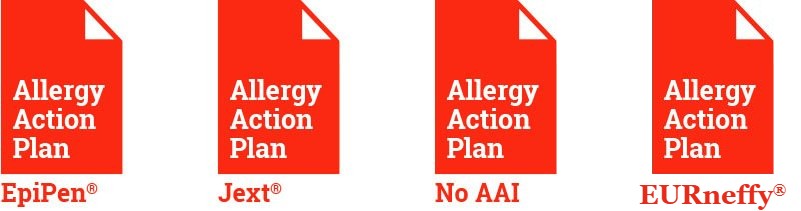
Allergy plans can be downloaded from the following links:
Asthma plans can be downloaded at: